Theresa Hak Kyung Cha’s Dictee 서포트그룹 / Support Group
Womb House Books / Oakland, CA
January 21, 2026, 7-9 pm
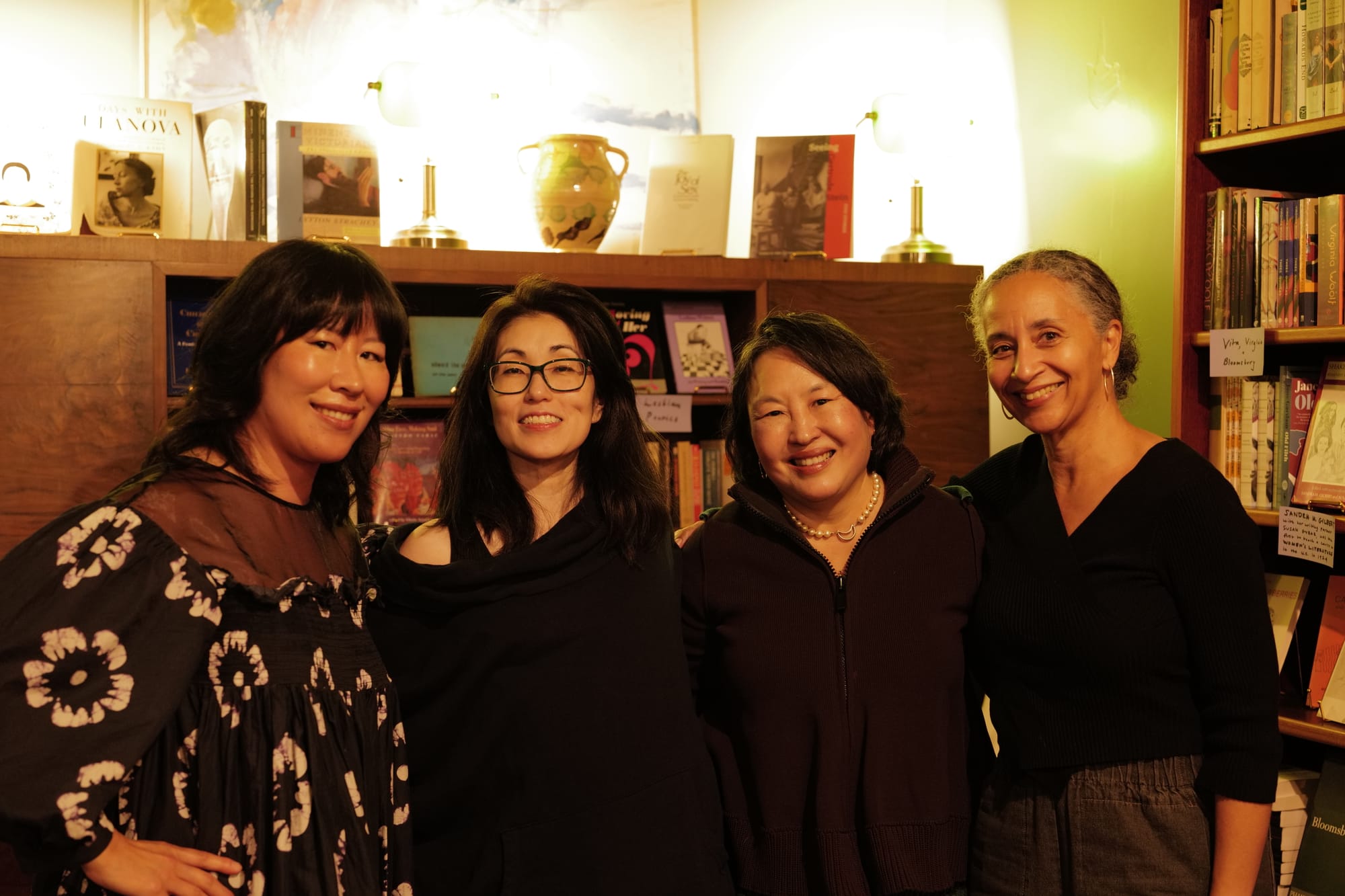
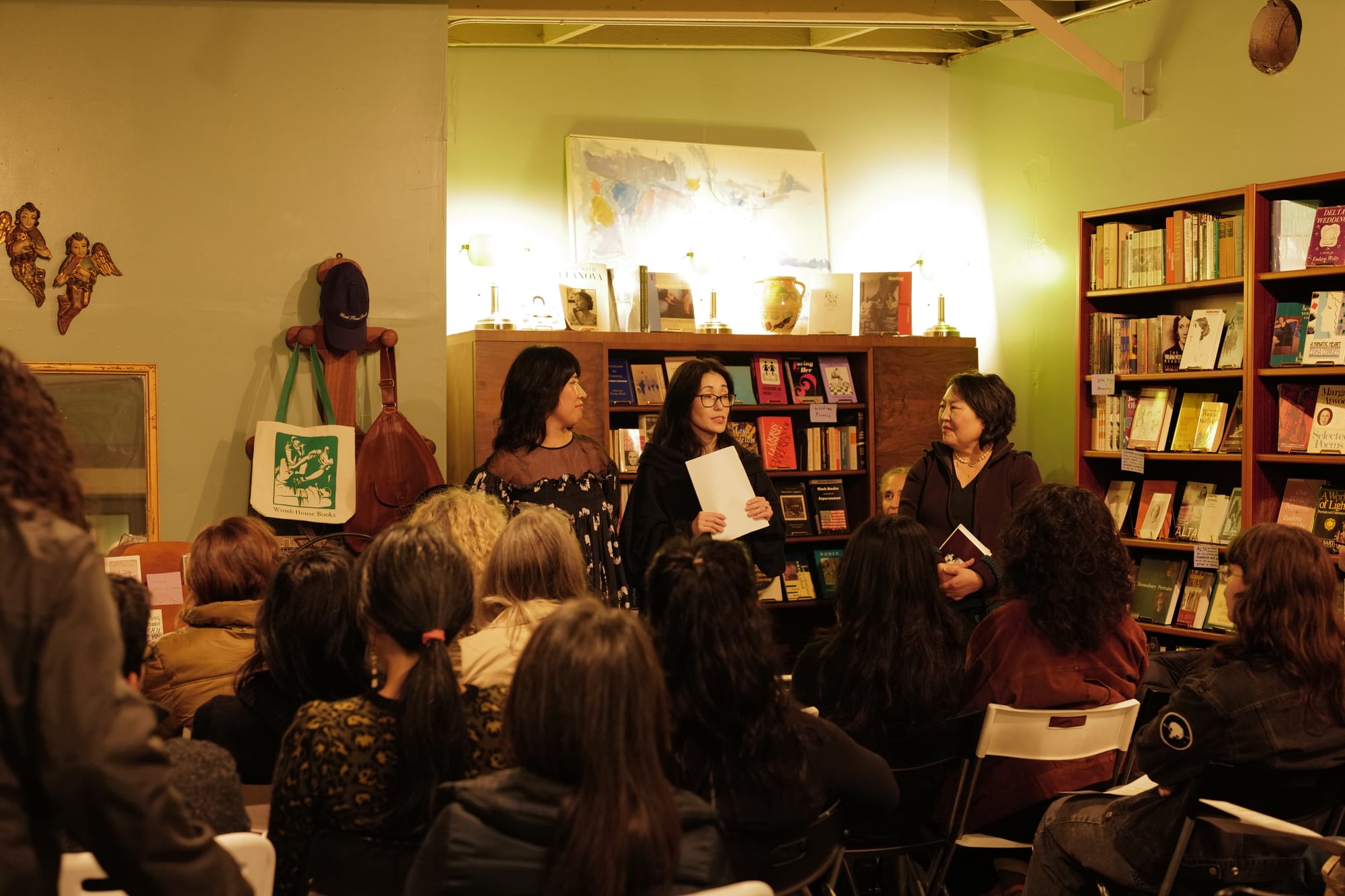
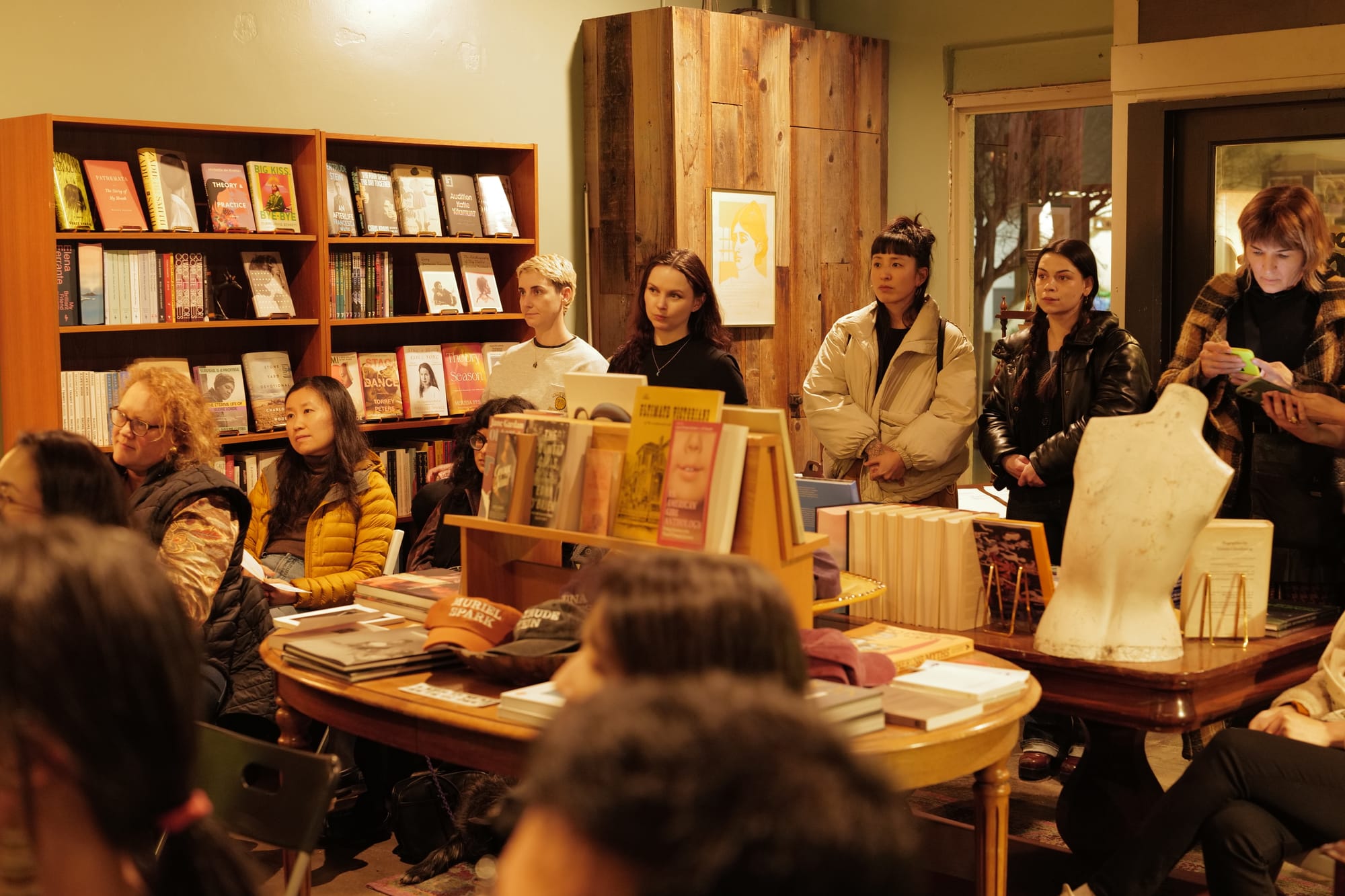
On a standing-room-only night at Womb House Books, Radical Ahjumma visor bearers Margaret Juhae Lee, S. Isabel Choi, and Nancy Jooyoun Kim discussed Theresa Hak Kyung Cha’s DICTEE, a genre-challenging ode to grief, memory, and love that centers women from myth, religion, history and Cha’s own ancestors. First published in 1982, DICTEE has emerged as a canonical work of feminist and Asian American studies with its themes of displacement, exile, and colonial violence that still resonate today.
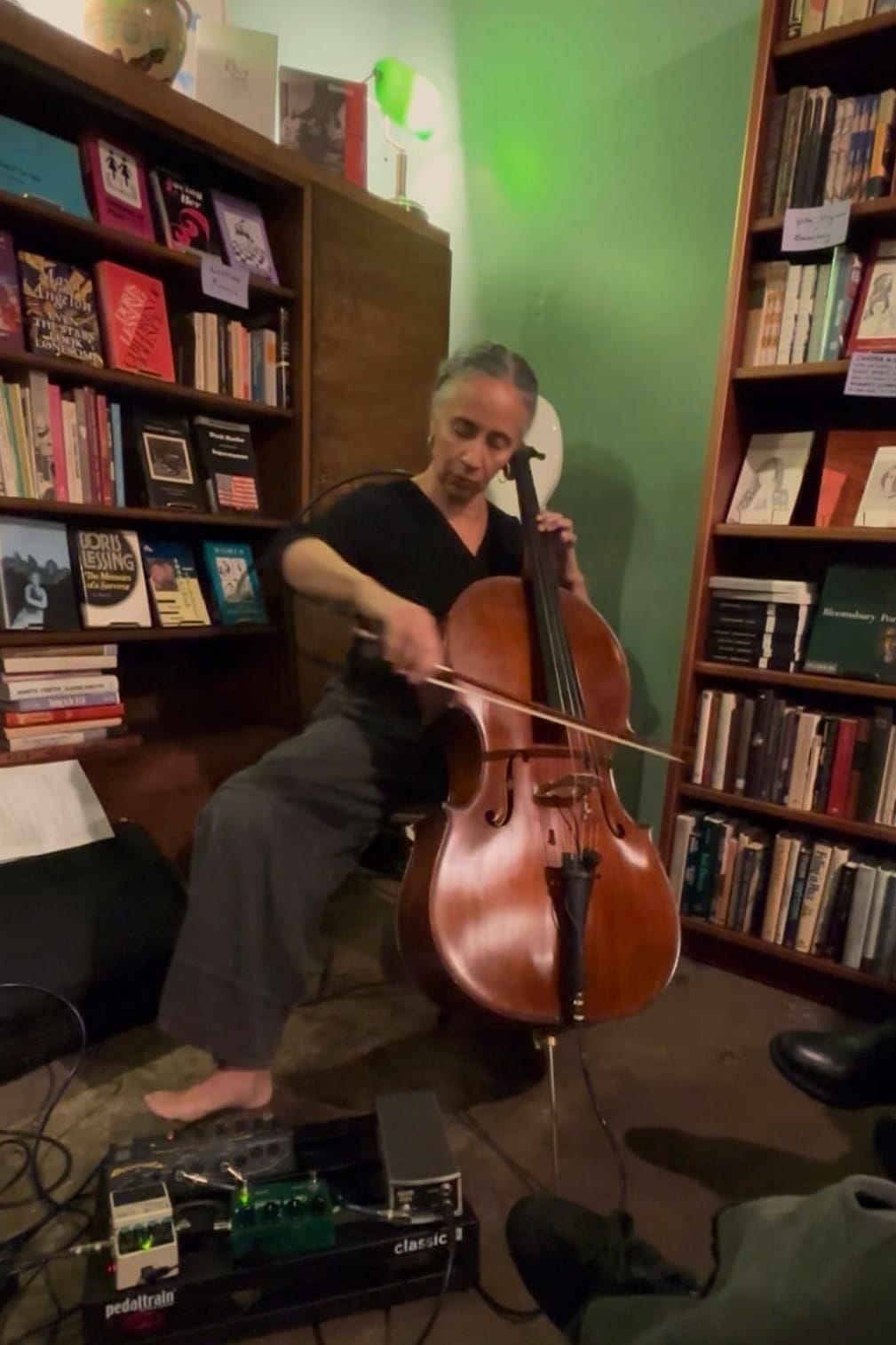
Christina Evans, Oakland-based interdisciplinary artist trained in music and dance, opened the night with a cello performance, an improvisation based on her previous collaboration with Korean shamanist dancer and ritualist Dohee Lee on a DICTEE project for BAMPFA in 2016.
Elder Ahjumma Margaret Juhae Lee began the DICTEE discussion describing how she knew Cha as an artist first, when she was a curatorial assistant at SFMOMA in the mid-1990s. Encountering her video work at the Berkeley Art Museum (Permutations, in particular) was revelatory—it was the first time she had seen a female Korean face in a museum setting.
She read passages from the chapters that most spoke to her: "Clio — History" and "Calliope — Epic Poetry." Clio focused on Yu Gwan Soon, the teenage martyr of Korea’s independence movement during the colonial era, who was imprisoned by the Japanese at the age of 16 and died under their watch after being tortured a year later. Calliope addressed Cha’s mother, Hyung Soon Huo, in the second person, who was born in Manchuria during the colonial era, whose mother tongue (Korean) was forbidden by the colonizer.
Margaret first read DICTEE in the 1990s, when her family discovered that her late grandfather, Lee Chul Ha, had been a leader in the student revolutionary movement. Previously, he had been “forgotten” after his death in 1936 at the age of 27, by both his wife, who burned all of his papers during the Korean War, and his country, who was not willing to acknowledge a Patriot who was also a Communist. This rediscovery of her grandfather’s life is the subject of her book, STARRY FIELD, A MEMOIR OF LOST HISTORY.
Our Emcee Ahjumma, slightly obsessed with modern Korean history, S. Isabel Choi discussed “Melpomene – Tragedy.” This chapter overlaps historically with the strongman regimes of Syngman Rhee, Park Chunghee, and Chun Doo-Hwan, men who ruled South Korea from 1948 to 1987.
“Melpomene” is part letter to Cha’s mother, part witness to the tear gas–riddled streets of Seoul in 1962 and 1980, and part incantation to the Greek muse of tragedy. This chapter collapses dates and time periods, as if to ask, “What is the point of time passing, if the tragedy of history does not change?”
“April 19” refers to April 19, 1960, the day of the April Revolution, when thousands of students led an uprising against Syngman Rhee for corruption and rigging an election. In “Melpomene,” Cha dates this iteration of April 19 as taking place in 1962, not 1960. Some surmise she misrecorded the date, but Isabel believes Cha referred to 1962 because that was the last year her family was in Korea before they emigrated to the States on political asylum.
Eighteen years later brings us to 1980, when Cha returns to Korea for the first time since leaving. By that time in Korea, Park Chunghee, who ruled for 18 years after seizing control by coup d’etat, has been assassinated. In the wake of his death, military general Chun Doo-hwan took over by phased coup d’etat in late 1979, and instituted martial law in 1980.
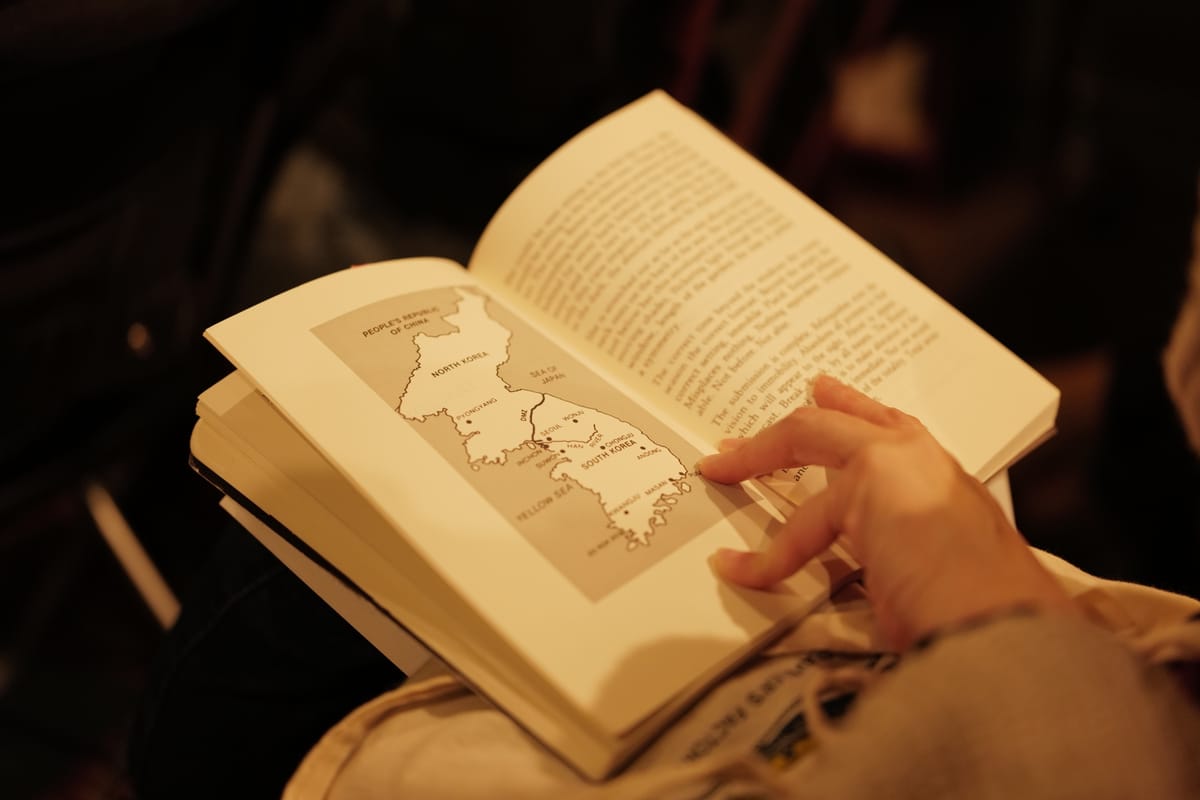
As an example of how DICTEE resonates even today, Isabel read aloud Cha’s descriptions of the military police in the streets, who fail to recognize the humanity of their fellow citizens – reminders of today’s immigration raids in the United States:
Cha despaired how Korea's history only repeated tragedy, without changing for the better. Had she not been murdered in 1982, she would have turned 75 this year. Had Cha survived, she would have seen significant movements toward democratization: After massive civilian protests throughout the 1980s, Chun Doo-Hwan finally stepped down in 1987, leading to the country's first true democratic presidential election. And in December 2024, the people of Korea did not stand for President Yoon Suk Yeol’s declaration of martial law. They filled the streets by the millions, and with a National Assembly that refused to cave in, martial law ended after six hours. President Yoon eventually was impeached and removed from office.
Ahjumma Nancy Jooyoun Kim focused on the last chapter, “Polymnia — Sacred Poetry,” and the final page of DICTEE, as an ode to not only the "mothers" who carry us so that we can see out the windows of our limitations, but also to our ability to lift and and serve others in return.
Nancy shared her first encounter with DICTEE as a tragic-romantic teenager in working-class Los Angeles with a predilection for women heroines who sacrificed themselves, sometimes as victims of state violence (ahem, Jeanne D’Arc). Being from a Catholic family, and now as a mother herself, she experiences DICTEE as a novena, a series of nine devotional prayers to nine women who should be not known for their tragic deaths, but for the ways they encourage us to stay alive through resistance, courage, and art.
DICTEE's final scene of the child imploring her mother to carry her is an invitation for us to also hold others and, with Cha’s radical audacity, to define and tangibly create our own canons. DICTEE itself is a kind of cathedral, a structure elaborately-designed and built like an altar that we may turn to in times of grief and darkness.
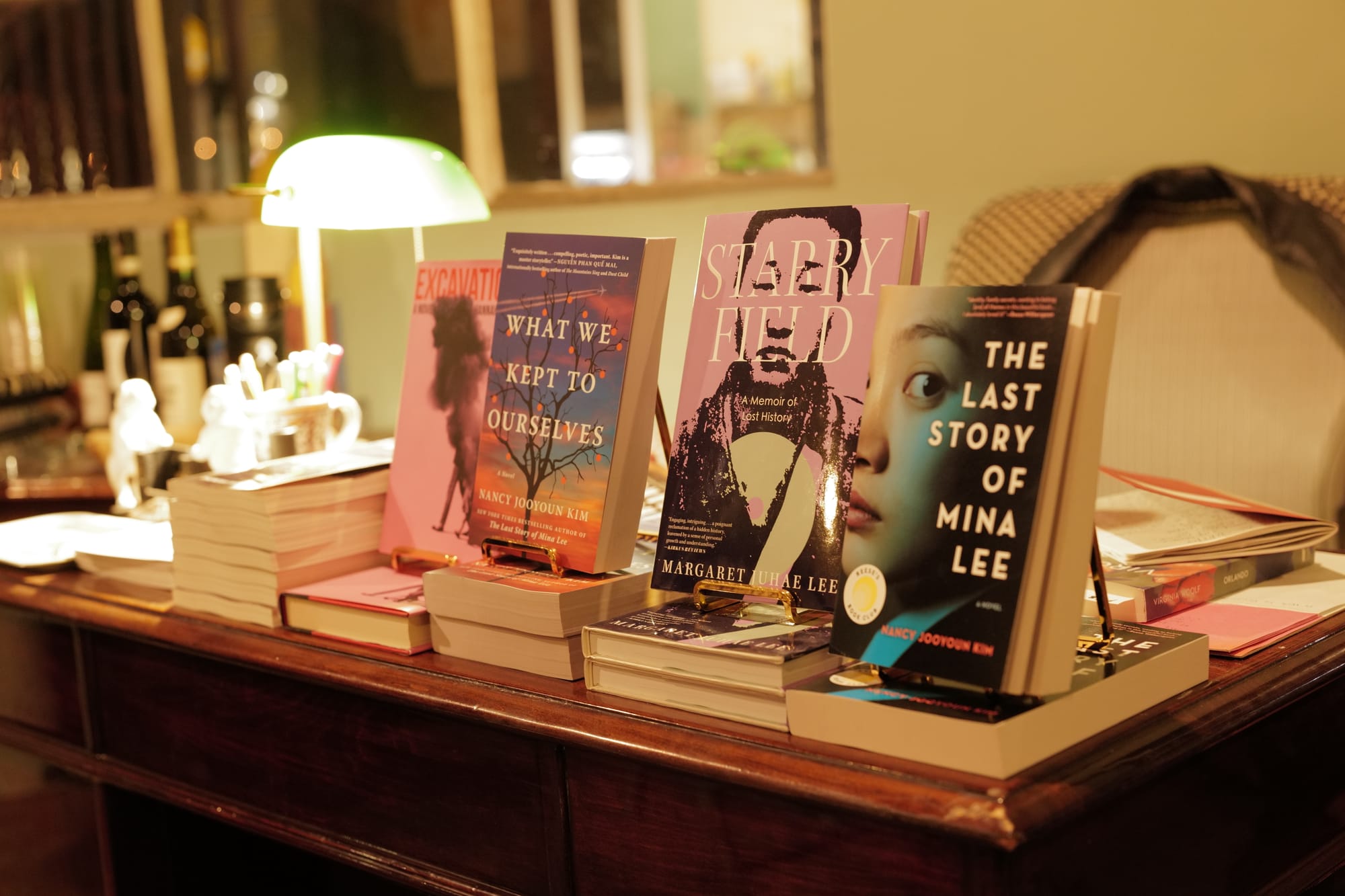
Discussing the influence of Cha’s work on her own writing, in particular her two novels, THE LAST STORY OF MINA LEE (2020) and WHAT WE KEPT TO OURSELVES (2023), Nancy wants to pay homage to Korean American women who fight against, and sometimes disappear, fall in love, and break laws to save themselves in a grotesquely patriarchal society (yes, America) where even our most intimate relationships (between mother and daughter, husband and wife) can fail to escape the internalization of white supremacy, colonialism, and misogyny. In the end, these women create safety through connection–with their pasts, the extraordinary heroism of the everyday, and the found families uniquely possible within the United States.
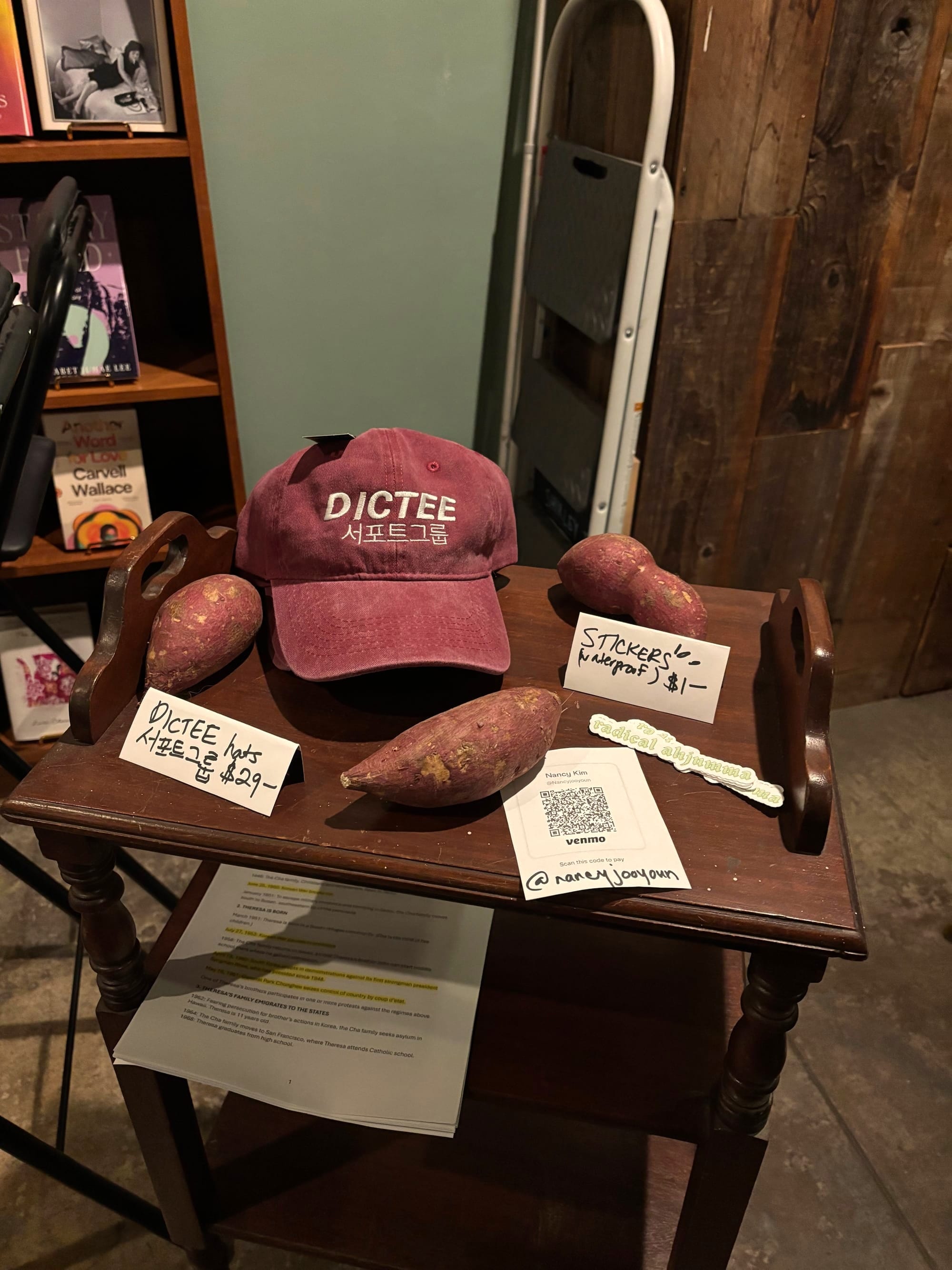
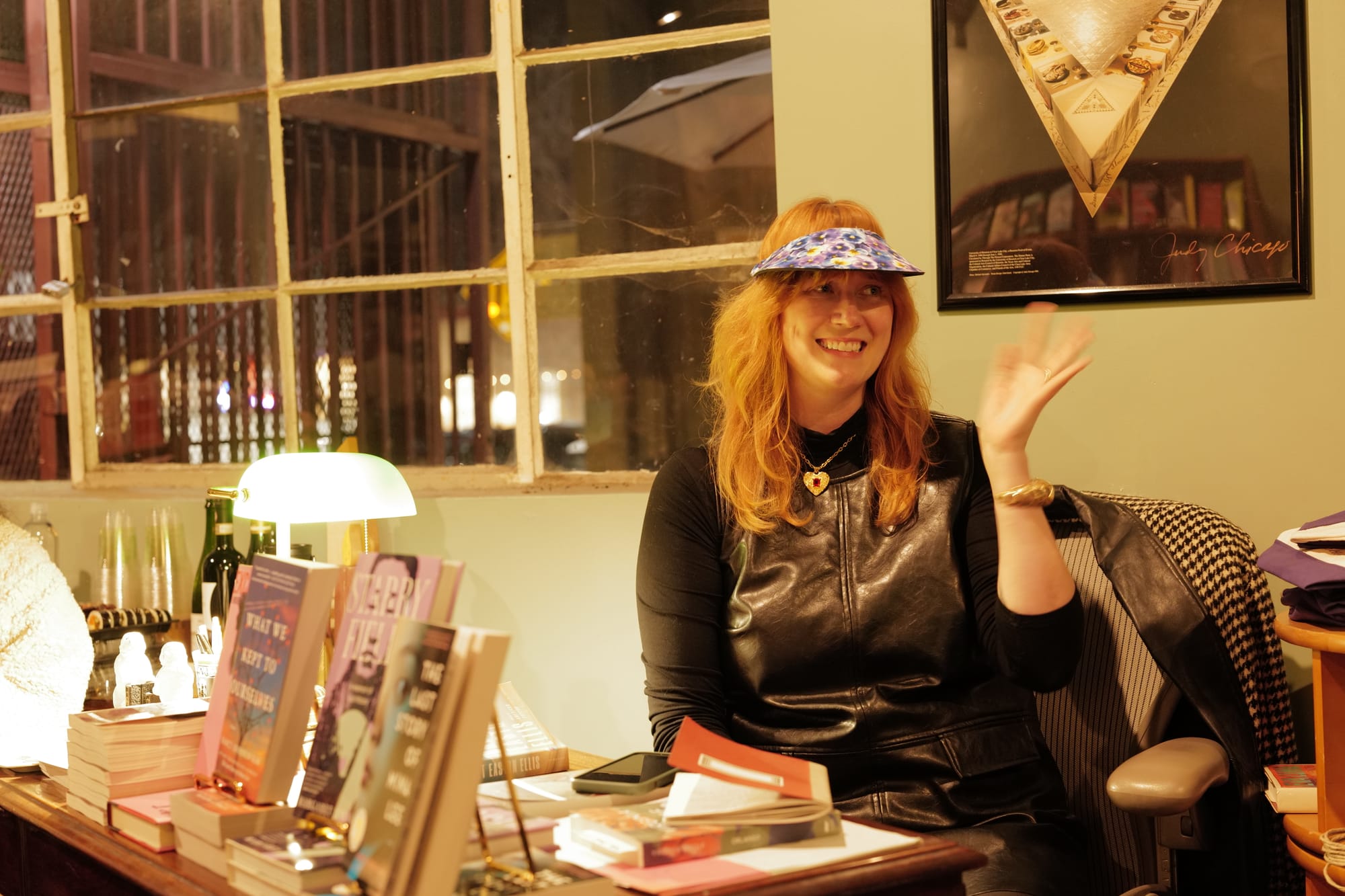
Thanks to our amazing audience who filled the room with love and attention. We were thrilled to have with us Tausif Noor, curator from BAMPFA, part of the team that organized the upcoming “Theresa Hak Kyung Cha: Multiple Offerings” retrospective, on view from January 24 to April 19, 2026. Much gratitude to author/journalist/photographer In Jeong Kim for her gorgeous photos of the event.
Many thanks to our host, Jessica Ferri, the owner of Womb House Books, who has supported Radical Ahjumma from the beginning. Our mutual first event was held in July 2025, a week after Womb House opened, and a week and a half after the first Radical Ahjumma lunch gathering at Joodooboo.